
Table of Contents
- Wall Art Size Guide for Living Room Walls: Start Here
- How to Measure Wall Space for Art Without Guessing
- Best Height to Hang Wall Art in a Living Room
- Standalone Piece or Gallery Wall: Choosing the Right Canvas Art Layout
- The Psychology of Negative Space: Why Less Avoids Clutter
- How Lighting Affects Canvas Art Size and Placement
- Choosing the Right Canvas Art Size: A Room-by-Room Decision Framework
- Conclusion
Last Updated: August 15, 2026
Wall Art Size Guide for Living Room Walls: Start Here
Choosing the right canvas art size for a living room wall determines whether your room feels cohesive or chaotic. Too small and the art looks like a postage stamp; too large and it overwhelms the space. The sweet spot lies in understanding your wall dimensions relative to your furniture, ceiling height, and the visual weight you want the piece to carry.
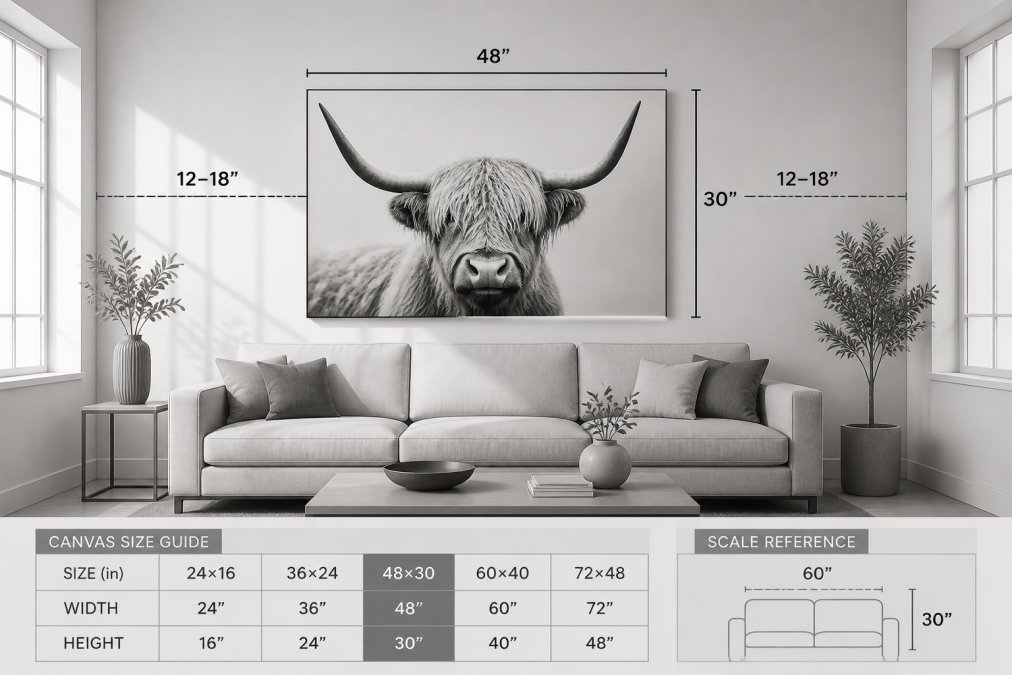
The 60-75% Rule Explained
The 60-75% rule is the most reliable starting point for canvas art size selection. Wall art should occupy between 60% and 75% of the available wall space above a piece of furniture, or 60-75% of the furniture's width when displayed above it.

For a sofa measuring 200 centimetres wide, your canvas should span between 120 and 150 centimetres. This range creates visual harmony without crowding the eye. Going below 60% produces that "too small" effect where the art floats disconnected from the furniture beneath it. Exceeding 75% risks making the space feel heavy and compressed.
Proportions for Sofas and Sectionals
Sectionals present a specific challenge because their L-shape creates an asymmetric footprint. Measure only the longest run of the sectional, then apply the 60-75% rule to that measurement. Centering art above the longest section grounds the composition without fighting the sectional's irregular shape.
For a standard three-seat sofa, a single canvas in the range of 90-120 centimetres wide is typically proportionate. For large sectionals extending beyond 280 centimetres, a gallery wall arrangement often serves better than a single oversized piece.
How to Measure Wall Space for Art Without Guessing
Measuring wall space accurately eliminates the most common sizing mistake: ordering by instinct and being wrong.
- Measure the full width of the wall from corner to corner.
- Identify the furniture the art will relate to and measure its width.
- Calculate 60-75% of whichever measurement is more constraining.
- Tape out the target dimensions on the wall and step back at least three metres.
- Adjust until the proportions feel balanced, then note your final dimensions.
Blank Walls vs. Walls Above Furniture
A blank wall with no furniture beneath it follows different logic. Here, the art becomes a standalone focal point. Large-scale art on an unanchored wall works best when it occupies 50-70% of the wall's total area, rather than the narrower 60-75% band applied above furniture. Without furniture as a visual anchor, smaller art tends to look lost.
Ceiling Height and Visual Weight
Ceiling height changes everything. Standard 240-centimetre ceilings suit artwork hung at conventional eye level, roughly 145-152 centimetres from the floor to the centre of the piece. Higher ceilings allow for taller canvases and stacked gallery arrangements that draw the eye upward and make the room feel more expansive.
A common mistake is hanging art too high on tall walls, which disconnects the piece from the living space below. On low ceilings, horizontal canvases keep the proportions from feeling cramped.
Best Height to Hang Wall Art in a Living Room
The standard hanging height for wall art in a living room is 145-152 centimetres from the floor to the centre of the artwork. This places the visual midpoint at average eye level for a standing adult, the benchmark used by most professional galleries and interior designers.
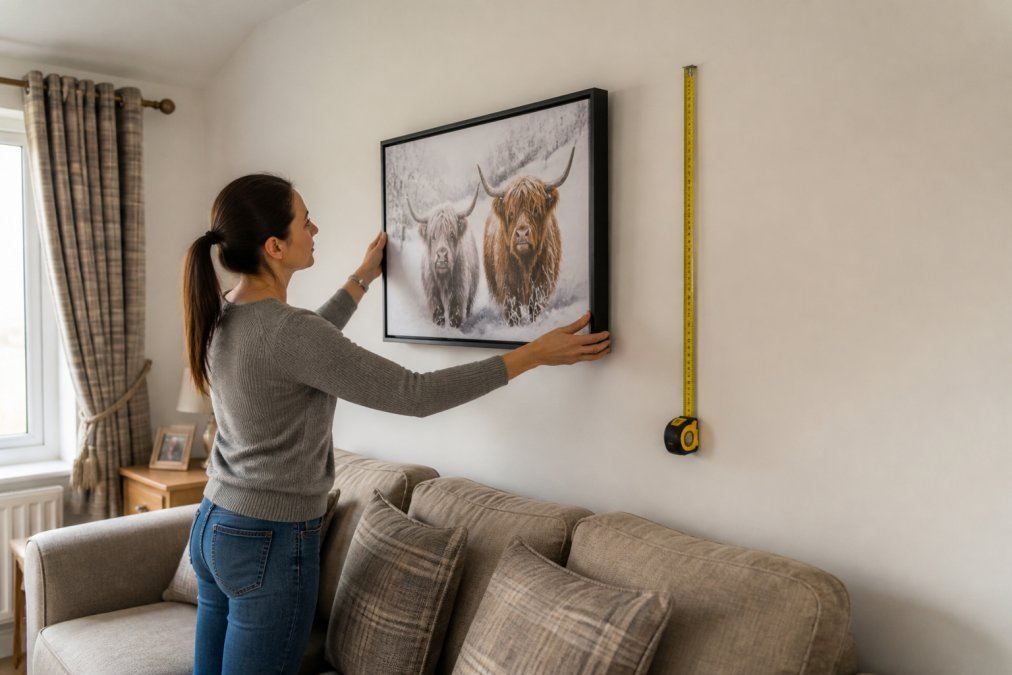
Above a sofa, aim for 15-20 centimetres of space between the top of the sofa back and the bottom edge of the canvas. This gap keeps the art visually connected to the furniture without crowding it. Above a fireplace mantle, the same 15-20 centimetre gap applies from the top of the mantle surface. For gallery walls, the centre of the entire arrangement should sit at that 145-152 centimetre mark.
Standalone Piece or Gallery Wall: Choosing the Right Canvas Art Layout
The choice between a single statement canvas and a gallery wall comes down to wall size, room complexity, and how much visual weight you want that wall to carry.
A standalone piece works best when the room already contains significant visual complexity, patterned textiles, or varied furniture forms. One strong canvas acts as a focal point without adding noise. Gallery walls distribute visual weight across a broader area and suit larger blank walls where a single large canvas would feel monotonous. Plan the arrangement on the floor before any nails go in, with consistent spacing of 5-8 centimetres between frames.
Vertical vs. Horizontal Orientation and Room Perception
Vertical canvases draw the eye upward, making ceilings feel higher and rooms feel more intimate. They suit narrow walls and alcoves. Horizontal canvases extend the eye across the wall, making rooms feel wider and more expansive. They are the natural choice above sofas because they mirror the horizontal plane of the furniture beneath them.
The Psychology of Negative Space: Why Less Avoids Clutter
Negative space is the unoccupied wall area surrounding the canvas. Most people treat it as empty space to be filled. Professional designers treat it as an active element of the composition.
Visual clutter triggers cognitive load. When a wall is covered with too many competing elements, the eye has nowhere to rest, and the room feels busy and tiring. Negative space gives the eye permission to stop, which paradoxically makes the art itself more impactful.
A single well-chosen canvas with generous negative space commands more attention than three mid-size pieces competing for the same wall. This is why the 60-75% rule is a ceiling, not a target. For living rooms with heavy furniture, patterned rugs, or multiple light sources, erring toward the lower end of the range often produces a more refined result.
How Lighting Affects Canvas Art Size and Placement
Lighting changes the perceived size and impact of canvas art in ways most sizing guides ignore. A canvas that looks correctly proportioned in natural daylight can feel overwhelming under warm artificial light or disappear under cool recessed lighting.
Natural light is the most flattering for canvas prints. A piece positioned where it receives indirect natural light will show its colours accurately and integrate with the room. For rooms relying primarily on artificial lighting, consider the direction and temperature of your light sources when choosing canvas size and placement. Spotlights positioned 30-45 centimetres above the canvas and angled at roughly 30 degrees create a wash of light that enhances texture and depth.
Shadow is the underrated factor. A large canvas in a poorly lit corner will lose its impact entirely, while a modestly sized piece under well-directed light can anchor a room with authority. Before finalising your canvas art size, assess the lighting conditions at different times of day.
Choosing the Right Canvas Art Size: A Room-by-Room Decision Framework
Every living room presents different constraints. Use this framework to match canvas art size to your specific situation.
| Room Scenario | Recommended Canvas Width | Layout Approach | Key Consideration |
|---|---|---|---|
| Small living room, single sofa | 80-100 cm | Standalone piece | Keep negative space generous |
| Medium room, 3-seat sofa | 100-130 cm | Standalone or pair | Match sofa width at 60-70% |
| Large room, sectional | 140-180 cm | Gallery wall or oversized single | Measure longest sofa run |
| Blank wall, no furniture | 90-140 cm | Statement piece, centred | Aim for 50-70% of wall width |
| Tall ceilings (270 cm+) | Portrait orientation, 60-90 cm wide | Vertical canvas or stacked gallery | Draw eye upward intentionally |
| Open-plan living area | 150 cm+ or gallery wall | Large scale to anchor the zone | Define the seating area visually |
The painter's tape test remains the most reliable final check regardless of what the measurements suggest.
Ben Ledi Print Media's Highland Cow Wall Art is designed to function as a standalone statement piece with enough visual weight to anchor a medium to large living room wall. Its canvas format suits the 100-130 centimetre width range that works above most standard sofas, and the warm tones respond well to both natural and warm artificial lighting.
The real difference between a canvas that transforms a room and one that merely occupies a wall comes down to proportion, placement, and the willingness to leave some wall space empty. Resist the urge to fill every centimetre. The most considered living rooms tend to have the most breathing room.
For rooms where you are genuinely uncertain, start smaller rather than larger. A canvas that is slightly too small can be supplemented with additional pieces or moved. A canvas that is too large for the wall is a much harder problem to solve.
Choosing the right canvas art size for a living room wall is one of the more consequential decisions in home decorating. Ben Ledi Print Media's handcrafted canvas prints are designed to take the guesswork out of the result: each piece is meticulously crafted with precision so that the colours, texture, and composition hold up at scale. Use the 60-75% rule to establish your target dimensions, confirm with the painter's tape method, and choose a piece with enough visual weight to anchor your wall without crowding it. Explore the Ben Ledi Print Media collection and add a canvas that genuinely fits your space.
Frequently Asked Questions
What is the rule of thumb for wall art size?
The most reliable starting point is the 60-75% rule: your canvas art should span 60-75% of the width of the furniture below it. For a 200 cm sofa, that means artwork between 120 cm and 150 cm wide. This proportion creates visual balance without overwhelming the room. For a large blank wall with no furniture anchor, aim for a piece that covers roughly two-thirds of the wall's width, leaving breathing room on each side.
How high should canvas art be hung above a sofa?
Leave 15-20 cm of space between the top of your sofa and the bottom edge of the canvas. This keeps the artwork visually connected to the furniture rather than floating on the wall. The centre of the piece should sit at roughly eye level, which for most living rooms falls between 140 cm and 150 cm from the floor. Hanging too high is the most common mistake, it disconnects the art from the room entirely.
Does large art make a small room look bigger?
A single large canvas art piece can make a small living room feel more spacious than several smaller pieces clustered together. Large-scale art draws the eye to one focal point, reducing visual clutter and making walls appear further away. Vertical compositions in particular add perceived height. The key is choosing one well-proportioned statement piece rather than filling every surface, negative space around the artwork is what creates the sense of openness.
How much space should be between canvas panels in a gallery wall?
For a cohesive gallery wall arrangement, keep spacing between individual canvas panels consistent at 5-8 cm. Tighter spacing (around 5 cm) reads as one unified composition, which suits smaller walls. Wider gaps (up to 8 cm) give each piece room to breathe and work better on larger walls. Avoid mixing gap sizes within the same arrangement, inconsistent spacing is the main reason gallery walls look unplanned rather than curated.
This article was written using GrandRanker