
Table of Contents
- What Canvas Print Turnaround Time Actually Means
- The Canvas Printing Process Step by Step
- Factors Affecting Canvas Production Speed
- Canvas Print Shipping Times: What to Expect
- Rush Order Canvas Printing: When You Need It Fast
- Planning Your Canvas Print Turnaround for a Gift or Event
- Why Handcrafted Canvas Prints Take the Time They Do
- Conclusion
Last Updated: August 16, 2026
What Canvas Print Turnaround Time Actually Means
Custom canvas print turnaround time is the total period between placing your order and receiving a finished piece at your door. At Ben Ledi Print Media, we hear this question constantly from customers planning gifts, decorating new homes, or working to a specific deadline. Understanding the answer properly requires separating two distinct phases: what happens in the studio and what happens in transit.
Most guides bundle these together and give you a single vague window. That approach sets people up for disappointment. The honest picture is more nuanced, and knowing the difference puts you in control of your timeline.
Production Time vs. Shipping Time: Two Separate Clocks
Production time is the period from order confirmation to a finished, packaged canvas ready for dispatch. This covers file review, colour preparation, printing, stretching, and quality inspection.
Shipping time is everything after the parcel leaves the studio. Carrier schedules, your location, and the service tier you select all influence this independently of anything the producer controls.
The practical implication: when a provider quotes you "5-7 days," always ask whether that means production only, shipping only, or both combined. Many customers assume it means delivery. Often it means production alone, with shipping added on top.
| Phase | What It Covers | Who Controls It |
|---|---|---|
| Production | File review, printing, stretching, finishing | The print studio |
| Shipping | Transit, carrier handling, last-mile delivery | The courier |
| Total Turnaround | Production + shipping combined | Both parties |
Keeping these two clocks in mind is the foundation for planning any canvas print order accurately.
The Canvas Printing Process Step by Step
Canvas print production is not a single action. It is a sequence of careful stages, each of which contributes to the quality of the finished piece. Rushing any one of them compromises the result.
File Review and Colour Preparation
The process begins before a single drop of ink is applied. Every file submitted by a customer must be reviewed for resolution, aspect ratio, and colour profile compatibility. A file that looks sharp on a phone screen may be too low-resolution to print at 60 × 40 cm without visible pixelation. This review stage catches those problems early.
Colour preparation follows. Screens display colours in RGB, while canvas printing uses CMYK ink sets. These are fundamentally different systems, and a direct conversion without adjustment can produce prints that look duller or more saturated than expected. Skilled colour preparation maps the digital file to the print medium so the output reflects the original image faithfully.
For standard orders with clean, high-resolution files, this stage typically takes a matter of hours. For files that need correction or resizing, it takes longer. This is not a bottleneck to resent; it is the stage that protects print quality.
Printing, Stretching, and Finishing
Once the file is approved and colour-corrected, it moves to the printer. Professional canvas printing uses large-format inkjet technology with pigment-based inks, which offer significantly better fade resistance than dye-based alternatives. The canvas material itself also matters: a tightly woven, artist-grade canvas accepts ink more evenly than a cheaper substrate, producing crisper detail and richer colour.
After printing, the canvas must dry fully before any handling. Attempting to stretch a canvas before the ink has cured risks smearing and surface damage.
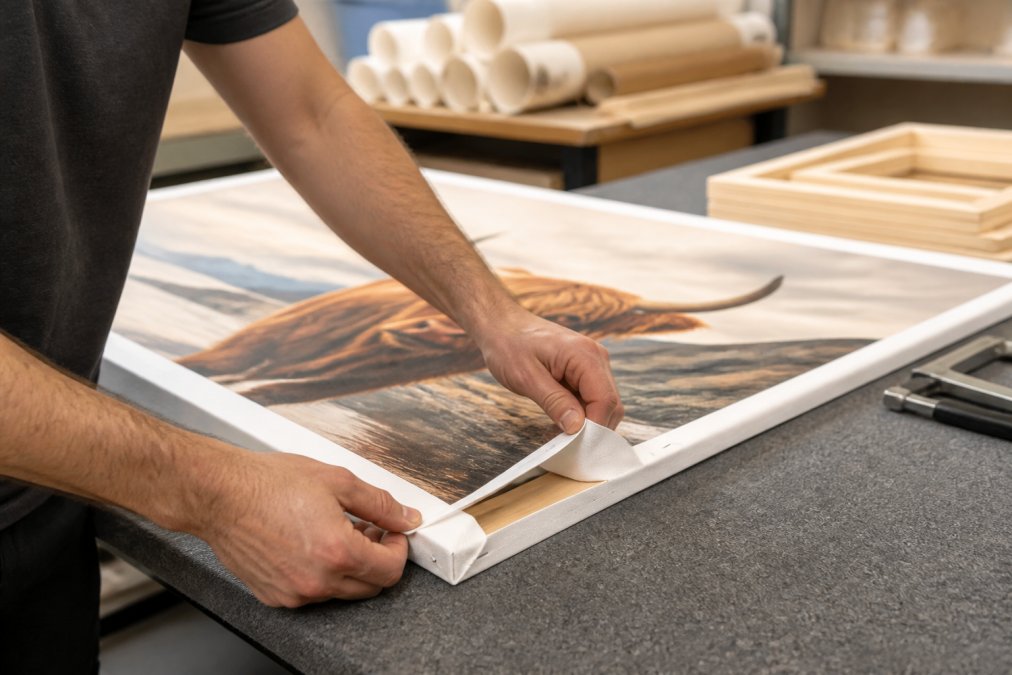
Stretching is where handcrafted production diverges most visibly from mass-produced alternatives. The printed canvas is pulled taut over a solid wooden frame, with corners folded and secured by hand. Tension must be even across the entire surface; uneven stretching causes warping over time. This stage requires skill and attention that cannot be fully automated.
A final inspection checks for print defects, frame alignment, and surface quality before the piece is packaged for dispatch.
Factors Affecting Canvas Production Speed
Several variables influence how quickly a canvas print moves through production. Understanding them helps you set realistic expectations and avoid unnecessary delays.
File quality is the single biggest variable within a customer's control. Clean, high-resolution images move straight to printing. Files that need correction, cropping, or resolution enhancement add time at the review stage.
Order volume at the studio affects queue position. Providers processing high order volumes, particularly around gift-giving seasons like Christmas, Mother's Day, and Valentine's Day, often have longer production queues. Ordering well ahead of peak periods is the most reliable way to avoid this.
Product complexity matters too. A standard rectangular print on a simple frame moves faster than a large multi-panel set or a piece requiring custom sizing. The more bespoke the specification, the more handling time it requires.
Handcrafted production methods inherently take longer than automated alternatives. This is not a flaw; it is the reason the finished product looks and feels different.
According to the British Printing Industries Federation guidance on print production, production timelines for specialist print products reflect the complexity of the process rather than inefficiency, and customers are advised to factor in preparation stages when planning orders.
Canvas Print Shipping Times: What to Expect
Canvas print shipping times vary based on destination, carrier, and the service level selected at checkout. For orders within the UK, standard tracked services typically deliver within two to five working days after dispatch. Express services can reduce this to one to two working days, though availability depends on the carrier and your location.
Remote or rural addresses sometimes fall outside next-day delivery zones, even with an express service selected. It is worth checking carrier coverage for your postcode if timing is critical.
International shipping adds complexity. Customs clearance, local carrier handoffs, and longer transit distances all extend delivery windows. Many providers offer tracked international shipping, but the tracking granularity varies significantly between carriers.
As noted in Royal Mail's guide to parcel delivery timescales, quoted delivery windows are estimates rather than guarantees, and factors outside carrier control, including high seasonal volumes and weather disruptions, can extend actual delivery times.
The practical advice: treat the quoted shipping window as a minimum rather than a fixed date, and build in a buffer of two to three extra days for anything time-sensitive.
Rush Order Canvas Printing: When You Need It Fast
Rush order canvas printing is a priority production option that moves your order to the front of the queue, reducing production time significantly compared to standard lead times. Many providers offer this as an add-on, though availability depends on current studio capacity.
The realistic expectation for a rush order is production within one to two working days, rather than the standard three to five. Combined with an express shipping service, this makes same-week delivery achievable for many UK addresses, though never guaranteed.
A few things to know before selecting rush production:
- File readiness matters more, not less. A rush order with a file that needs correction will still be delayed at the review stage. Have your image ready and at the correct resolution before you order.
- Rush options are typically unavailable during peak periods. Studios running at full capacity around Christmas or other high-demand windows often suspend rush production entirely.
- Cost increases proportionally. Priority handling carries a premium, and express shipping adds further to the total. Weigh this against the alternative of ordering earlier.
For genuinely urgent situations, the best approach is to contact the studio directly before placing an order. Confirming current capacity and realistic timelines takes two minutes and prevents a lot of frustration.
Planning Your Canvas Print Turnaround for a Gift or Event
The biggest mistake people make when ordering a canvas print as a gift is leaving too little margin. A common scenario: someone orders with a week to spare, assumes production and shipping are both fast, and the piece arrives two days after the event.
The UK consumer guidance on online shopping delivery rights notes that delivery date estimates are not contractual guarantees in most cases, which is why building a buffer into your planning is essential rather than optional.
A practical planning framework:
| Situation | Recommended Lead Time | Notes |
|---|---|---|
| Housewarming or birthday gift | 2-3 weeks before event | Allows standard production + shipping + buffer |
| Christmas gift | Order by early December | Peak season extends all timelines |
| Same-week delivery needed | Rush production + express shipping | Confirm availability with studio first |
| Large or custom size | 3-4 weeks minimum | More complex production stages |
The throughline here is simple: the earlier you order, the more options you have. Ordering three weeks out gives you access to standard production at standard pricing. Ordering three days out forces you into rush options that cost more and depend on studio availability.
Why Handcrafted Canvas Prints Take the Time They Do
Handcrafted canvas prints take longer to produce because each piece is handled individually at multiple stages, rather than moving through an automated production line with minimal human involvement. The difference shows in the finished product in ways that matter over years of display.
Mass-produced alternatives prioritise throughput. Canvases are stretched by machine, inspected by exception rather than by default, and packaged at speed. The result is consistent in the sense that every piece is equally average.
Handcrafted production works differently. Each piece is stretched by hand, with tension checked across the frame before finishing. Corners are folded with care rather than stapled mechanically. The inspection stage is genuine rather than cursory.
What this means in practice: a handcrafted canvas is less likely to arrive with uneven tension, visible staple lines on the face of the canvas, or colour that bears little resemblance to the original image. These are the failure modes that owners of mass-produced pieces encounter most often.
The time investment in production is also what makes the piece worth displaying for years rather than months. Pigment-based inks on quality canvas, properly stretched on a solid frame, resist fading and warping in ways that cheaper alternatives do not. According to guidance from the Fine Art Trade Guild on print longevity, archival-quality pigment inks on appropriate substrates can maintain colour integrity for decades under normal display conditions.
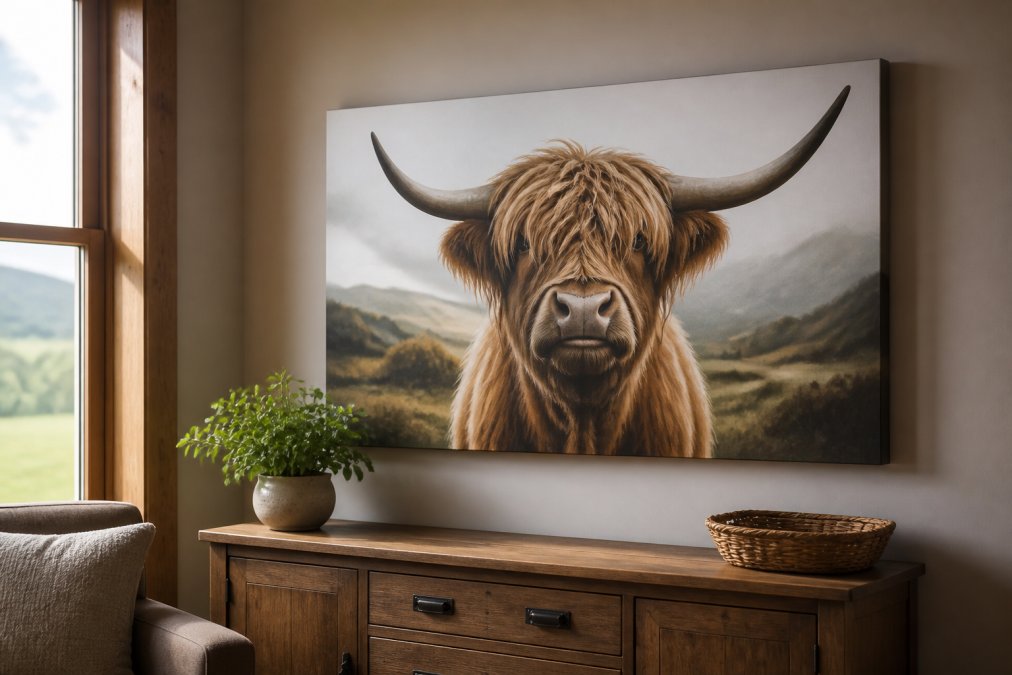
The Ben Ledi Print Media collection, including pieces like the Highland Cow Wall Art designed for home decor, reflects this commitment. Each canvas is meticulous in its preparation precisely because the goal is a piece that genuinely elevates a space rather than simply filling a wall.

The honest answer to "why does it take this long?" is that the time is where the quality lives.
Planning a canvas print order around a deadline is straightforward once you understand that production and shipping are separate timelines with different variables. The challenge most buyers face is not the process itself but the assumption that everything will happen faster than it actually does. Ben Ledi Print Media's handcrafted approach to canvas production, from careful file preparation through to hand-stretched finishing, means each piece takes the time it genuinely requires. Browse the collection, confirm your timeline with the studio, and add a canvas print to your space with confidence that what arrives will be worth the wait.
Frequently Asked Questions
How long does it typically take to get a custom canvas print?
Most custom canvas prints involve two separate timeframes: production and shipping. Production for a handcrafted piece generally takes 3 to 7 business days, depending on order volume, print complexity, and finishing requirements. Shipping adds further time on top of that, typically 2 to 5 business days for standard delivery within the UK. Ordering early and supplying a high-resolution image at checkout are the two most reliable ways to keep the total wait as short as possible.
Is there a difference between production time and shipping time?
Yes, and confusing the two is one of the most common reasons people receive their canvas print later than expected. Production time covers everything from file review and printing to stretching and quality checking. Shipping time begins only once the finished piece leaves the studio. When a provider quotes a delivery estimate, check whether that figure includes production or refers only to transit. For a canvas print turnaround that fits a deadline, always add both figures together.
What factors cause delays in canvas print production?
Several things slow production down: low-resolution image files that need manual correction, high seasonal order volumes around Christmas or Valentine's Day, complex finishing requests such as gallery wraps on large formats, and artwork that requires colour calibration before printing. Submitting a sharp, high-resolution file and ordering outside peak periods removes most of these variables. Handcrafted pieces also involve more manual steps than automated print runs, which adds care but also time.
How can I speed up the delivery of my custom canvas print?
The fastest route is to check whether the provider offers a rush order canvas printing option, which typically moves your job to the front of the production queue for an additional fee. Beyond that, upload the highest-resolution file you have, avoid requesting non-standard sizes that require custom frame cutting, and place your order on a Monday or Tuesday to avoid weekend delays. Choosing an expedited shipping tier at checkout will then reduce transit time once the piece is ready to dispatch.
This article was written using GrandRanker