
Table of Contents
- What to Check Before Hanging Art in a Rental
- Damage-Free Wall Hanging Tools for Renters
- Hanging Art in Rented Homes Without Nails
- Heavy-Duty Solutions for Larger Canvas Prints
- Renter-Friendly Gallery Wall Ideas
- How to Patch Nail Holes in Rental Walls Before Moving Out
- Tips for Hanging Art in Rented Homes: Surface-Specific Advice
- Conclusion
Last Updated: August 16, 2026
Renting shouldn't mean living with bare walls. Yet many tenants hesitate to hang anything, worried about losing their security deposit or violating their lease. This guide from Ben Ledi Print Media covers practical, renter-friendly strategies for displaying artwork beautifully without causing lasting damage. Below, you'll find surface-specific advice, damage-free wall hanging tools, and tips for hanging art in rented homes that work whether you're in a modern flat or a Victorian terrace.

What to Check Before Hanging Art in a Rental
Before a single hook touches your wall, check two things: your lease and your wall surface. Skipping either step is the most common mistake renters make.
Reading Your Lease Agreement
Your lease agreement is the starting point for any wall hanging decision. Many tenancy agreements explicitly state whether tenants may hang artwork, what methods are permitted, and what constitutes damage requiring repair. Check for clauses covering "alterations," "fixtures," or "damage." If your lease is ambiguous, ask your landlord directly and get the response in writing. According to guidance from Shelter's tenant rights resources, tenants can be held liable for damage beyond fair wear and tear, which means understanding your obligations before you start is essential.
Identifying Your Wall Type
Wall type determines everything: what adhesives will stick, how much weight a mounting solution can hold, and how difficult repairs will be if something goes wrong.
The most common wall types in UK rentals:
- Plaster over brick or block - Dense and load-bearing. Adhesive strips bond well here, and small nails cause minimal damage.
- Plasterboard (drywall) - Lighter and more fragile. Heavy artwork needs wall anchors or studs. Adhesive strips work well for lighter pieces.
- Textured or patterned walls - Rough surfaces reduce adhesive contact area, lowering the effective weight capacity of any strip or hook.
- Painted surfaces - Fresh or glossy paint can cause adhesive strips to fail. Wait at least a week after any new painting before applying removable adhesives.
Tap your wall gently. A hollow sound indicates plasterboard; a solid thud suggests brick or block.
Damage-Free Wall Hanging Tools for Renters
The market for damage-free wall hanging tools has expanded considerably, giving renters more reliable options than ever before.
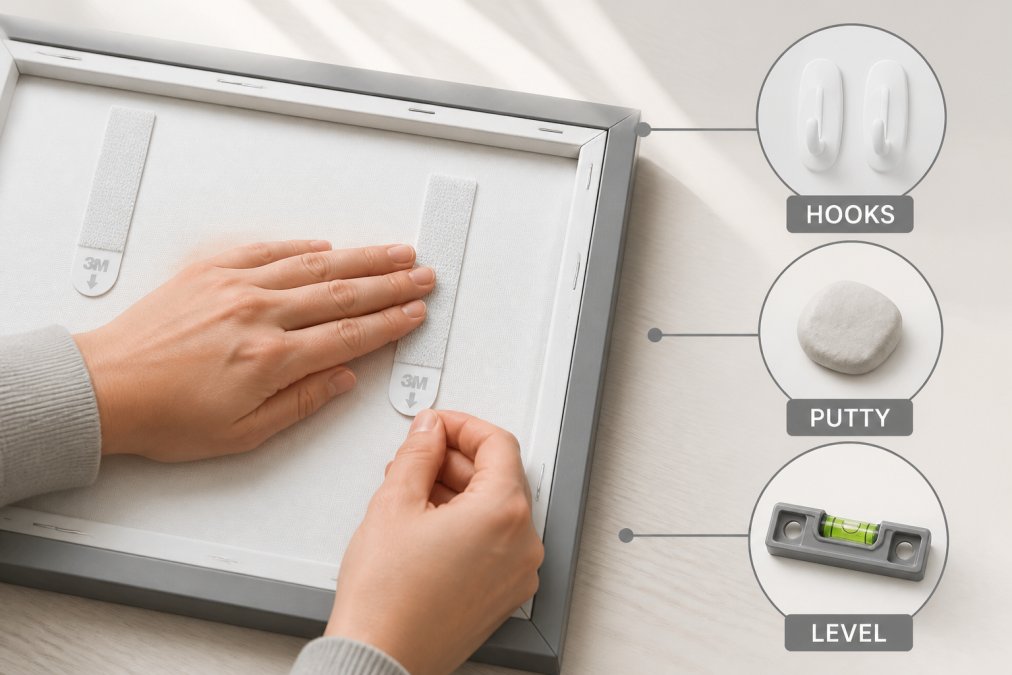
Adhesive Strips and Command Hooks
Adhesive strips are the most widely used damage-free hanging solution for renters. When used correctly, they leave no residue and remove cleanly. Most failures happen because of surface preparation errors or exceeding the stated weight capacity.
Before applying any adhesive strip:
- Clean the wall surface with isopropyl alcohol and let it dry completely.
- Press the strip firmly against the wall for 30 seconds.
- Wait the full cure time (typically one hour before hanging anything).
- Never exceed the manufacturer's stated weight limit, and always use multiple strips for heavier pieces.
For a framed piece weighing under 2 kg, a pair of correctly applied strips handles the load comfortably on smooth plaster or plasterboard. On textured walls, the effective weight capacity drops substantially.
Wall Putty, Sticky Tack, and Glue Dots
Wall putty and sticky tack are better suited to very lightweight items: small unframed prints, paper artwork, or thin canvas panels. Use enough material under each corner to distribute the load evenly. Glue dots offer a slightly more secure bond and work well on smooth surfaces.
Neither should be trusted for anything with significant weight.
Velcro Strips and Picture Wire Options
Industrial-strength velcro strips offer a capable hanging solution for medium-weight artwork. The hook-and-loop system distributes weight across a wider surface area than a single adhesive point.
Picture wire works well when combined with a small adhesive hook or an existing picture rail. Many older UK properties have picture rails already installed, which are purpose-built for hanging artwork without touching the wall surface below. If your rental has them, use them, they're the cleanest solution available.
Hanging Art in Rented Homes Without Nails
Avoiding nails entirely is both possible and practical for most artwork sizes.
Leaning Art Against Walls and on Shelves
Leaning art is the most underrated approach in any guide on tips for hanging art in rented homes. A large canvas print leaned against a wall on a mantle, console table, or windowsill creates a relaxed, gallery-like aesthetic that's completely damage-free.
This works especially well for larger pieces where adhesive strips would struggle with the weight. A 60 cm canvas leaned against a wall on a deep shelf looks intentional and considered. Ensure the shelf is deep enough that the piece won't tip forward, and use a small piece of sticky tack at the base to prevent sliding.

Floating Shelves, Mantles, and Rail Systems
Floating shelves installed with removable adhesive anchors can hold lightweight framed pieces without drilling. Check the weight rating carefully, as adhesive-mounted shelves have lower load limits than drilled alternatives.
Gallery rail systems, where a horizontal rail mounts near the ceiling and artwork hangs from wires or rods, are worth discussing with your landlord. A single rail installation causes minimal wall damage and allows unlimited rearrangement of artwork below it. According to advice on picture rails and renter modifications, tenants can sometimes negotiate minor improvements with landlord consent.
Heavy-Duty Solutions for Larger Canvas Prints
Larger canvas prints, anything above roughly 50 x 70 cm or heavier than 5 kg, require more than standard adhesive strips. The most reliable damage-free option is a combination approach: heavy-duty adhesive strips rated for the specific weight, applied to a clean, smooth surface, combined with a picture wire across the back of the canvas to distribute load across two anchor points.
For very large or heavy pieces, a small nail or picture hook may be the only genuinely safe option. A single small nail creates a pinhole that's straightforward to repair when you leave.
| Solution | Weight Capacity | Best For | Rental Risk |
|---|---|---|---|
| Adhesive strips (standard) | Up to 2 kg | Lightweight canvas prints | Very low |
| Heavy-duty adhesive strips | Up to 7 kg | Medium framed pieces | Low |
| Velcro strips | Up to 4 kg | Medium prints, smooth walls | Low |
| Small nail or pin | Up to 15 kg | Heavier framed artwork | Minimal (patchable) |
| Picture rail system | Variable | Multiple pieces, large collections | Very low |
| Leaning on shelf/mantle | Unlimited | Large canvas, oversized prints | None |
Renter-Friendly Gallery Wall Ideas
A gallery wall is achievable in a rental, but it requires planning. Lay out your prints on the floor, spacing them 5-8 cm apart, and photograph the arrangement from above before touching the wall.
For a fully damage-free gallery wall:
- Use adhesive strips rated for each individual piece's weight
- Space hooks at consistent intervals using a spirit level
- Mix leaned pieces on a shelf with hung pieces above to reduce wall contact points
- Use a picture rail if one exists
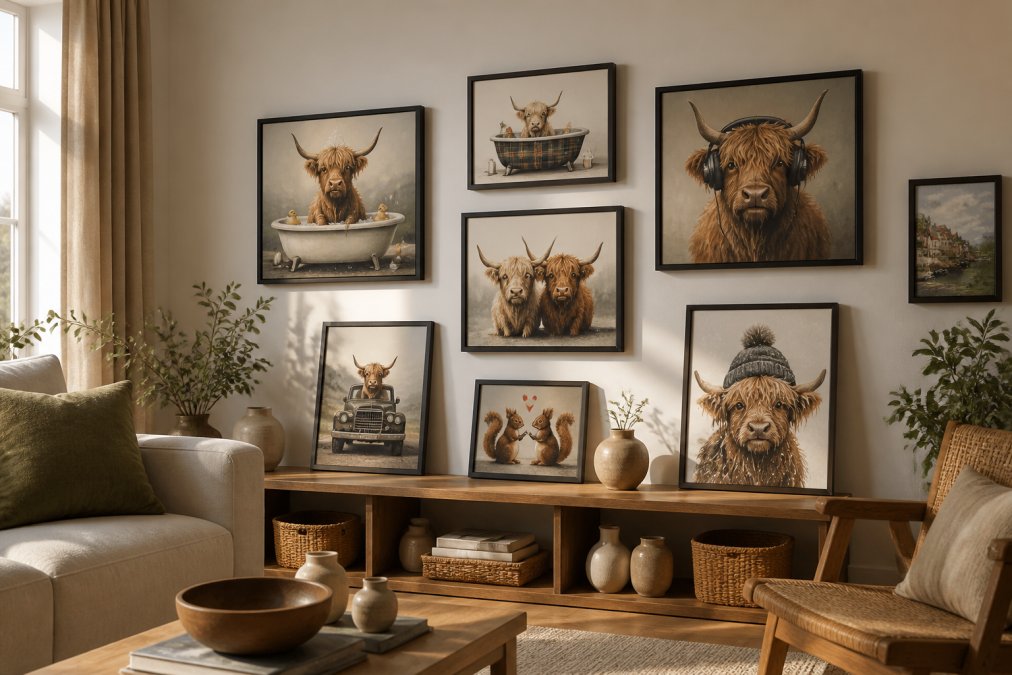
The most effective renter-friendly gallery walls combine two or three adhesive-hung pieces with one or two leaned pieces on a shelf below. This reduces the number of adhesive points on the wall and creates a layered, dimensional display.
Ben Ledi Print Media's handcrafted canvas prints are particularly well-suited to this kind of arrangement. The Highland Cow Wall Art and the Wee Girl & the Highland Cow canvas both come framed and ready to hang, making them straightforward to incorporate into a leaned or adhesive-hung gallery display.

How to Patch Nail Holes in Rental Walls Before Moving Out
Small nail holes are the most common source of security deposit disputes, and they're also the easiest to fix.
Patching nail holes in rental walls is straightforward:
- Clean the hole - Remove any loose plaster or debris with a dry cloth.
- Apply filler - Use a ready-mixed wall filler or spackle, pressing it into the hole with a putty knife.
- Smooth the surface - Feather the filler outward so it blends with the surrounding wall texture.
- Sand when dry - Once fully dry (typically 2-4 hours), sand lightly with fine-grit sandpaper.
- Touch up the paint - Use a paint-matching service at a hardware store, or check whether your landlord has leftover paint stored in the property.
According to government guidance on tenancy deposit disputes, landlords must demonstrate that any deduction from a deposit reflects actual damage beyond fair wear and tear. A properly patched and painted nail hole generally falls within acceptable repair standards.
Tips for Hanging Art in Rented Homes: Surface-Specific Advice
Surface compatibility is the factor most guides overlook entirely. The same adhesive strip that holds a canvas print perfectly on smooth plasterboard can fail completely on a textured or freshly painted wall.
Smooth plaster or plasterboard: Most adhesive strips and hooks perform at or near their rated capacity. Clean with isopropyl alcohol before application and allow full cure time.
Textured or rough walls: Reduce the expected weight capacity of any adhesive by at least 40%. Use more strips than you think you need, and consider leaning heavier pieces rather than hanging them.
Gloss or semi-gloss painted surfaces: Adhesive strips bond poorly to high-sheen paint. Test a small strip in an inconspicuous area for 24 hours before committing.
Plaster over brick (older properties): Generally reliable for adhesive strips on smooth sections. Small nails work well here and cause minimal damage.
Tiled or panelled surfaces: Standard adhesive strips are not designed for these surfaces. Use specialised tile-safe adhesive products, or choose a leaning or shelving solution instead.
Residue removal is also surface-specific. On smooth painted walls, isopropyl alcohol removes most adhesive residue without affecting the paint. On textured or delicate surfaces, test any solvent in a hidden area first.
Renting doesn't mean choosing between personalised walls and your security deposit. With the right approach matched to your specific wall surface, you can display artwork confidently and leave the property in the same condition you found it.
Ben Ledi Print Media's canvas collection, from the character-filled Coo At The Races to the warmly detailed Coo Love Highland Cow print, is designed with exactly this kind of flexibility in mind. Each piece is lightweight, framed, and ready to display using the damage-free methods covered throughout this guide.
Personalising a rented space shouldn't feel like a risk. The methods in this guide give you practical, tested options for displaying artwork without jeopardising your deposit or your relationship with your landlord. Ben Ledi Print Media offers a curated collection of handcrafted canvas prints, including the Highland Cow Wall Art and the Wee Girl & the Highland Cow canvas, that are sized and constructed to work beautifully with damage-free hanging solutions. Browse the collection and find the piece that transforms your rental into a space that genuinely feels like yours.
Frequently Asked Questions
What is the best way to hang pictures in a rental property?
Adhesive strips such as Command strips are the most popular damage-free option for renters. They hold most lightweight to medium-weight frames securely and remove cleanly from painted drywall. For heavier canvas prints, gallery rail systems or leaning art on floating shelves avoids wall contact entirely. Always check the product's weight capacity before installation, and test a small area first if your walls have textured or plaster surfaces.
Are Command strips safe for all rental wall types?
Command strips work reliably on smooth painted drywall, but they can pull paint or cause damage on textured walls, fresh paint, wallpaper, or older plaster walls. On these surfaces, wall putty or sticky tack is a safer choice for lighter pieces. Always follow the removal instructions precisely, pulling the tab slowly at a low angle minimises the risk of residue or paint lifting, protecting your security deposit.
How do you hang heavy art in a rental without nails?
For canvas prints above roughly 3-4 kg, standard adhesive strips may not be sufficient. Options include heavy-duty adhesive hooks rated for higher weight capacities, gallery rail systems fixed to the ceiling or picture rail moulding (which avoids wall damage entirely), or leaning larger pieces against the wall on a floating shelf or mantle. Always check the manufacturer's stated load-bearing limit and consider splitting the weight across two anchor points.
Can you use putty to hang art in a rental?
Yes. Wall putty and sticky tack are good renter-friendly choices for lightweight prints and smaller frames. They leave minimal residue and rarely damage paint on smooth walls. They are not suitable for heavy pieces, and on porous or delicate surfaces they can occasionally lift paint. Remove putty by rolling it off gently rather than pulling sharply. For best results, press the putty into small balls at each corner of the frame backing before mounting.
This article was written using GrandRanker