
Table of Contents
- Why Mixing Canvas Art Sizes Works Better Than Matching Sets
- Start With a Focal Point and Build Outwards
- Gallery Wall Layout Ideas That Balance Different Sizes
- How Much Spacing Between Wall Art Should You Leave?
- Symmetrical vs Asymmetrical Wall Art: Which Suits Your Room?
- Mixing Canvas Prints With Framed Art and Photo Boards
- Using Paper Templates to Plan Before You Drill
- Choosing Art for Specific Rooms: Sofa Walls, Mantels and Beds
- Weight, Hardware and Lighting: The Details Most Guides Skip
- Common Mistakes to Avoid When Mixing Canvas Art Sizes
- Frequently Asked Questions
Last Updated: September 15, 2026
Why Mixing Canvas Art Sizes Works Better Than Matching Sets
Matching sets feel safe, but they rarely make a wall memorable. Learning how to mix and match canvas art sizes gives you something a uniform set cannot: rhythm, hierarchy and a space that looks collected rather than catalogue-ordered.
The hesitation is unnecessary. A large focal canvas surrounded by two or three smaller pieces creates visual balance that a single oversized print cannot achieve. The eye moves, rests, then moves again.
Below, we break down focal points, gallery wall layout ideas, spacing rules and the hardware details most guides skip. Every technique here works whether you are hanging two prints or twelve.
Start With a Focal Point and Build Outwards
Choose one anchor piece first, then size everything else around it. The anchor is usually your largest canvas, placed at the visual centre of the arrangement. It carries the theme and the colour story.
A common mistake is buying several medium canvases at once and hoping they resolve into a composition. They rarely do. Start with one statement piece, live with it for a week, then add.
Practical sequence:
- Hang the anchor at eye level, roughly 145cm from the floor to the centre of the canvas.
- Measure the remaining wall width on both sides.
- Add smaller pieces only where the gap looks unbalanced, not where it looks empty.
This is where most people rush. The gap that bothers you on day one often resolves once furniture and lighting settle in.
Gallery Wall Layout Ideas That Balance Different Sizes
A gallery wall works when every piece has a job: anchor, support or accent. Balance comes from distributing visual weight, not from matching dimensions. A heavily detailed small canvas can hold as much attention as a large plain one.
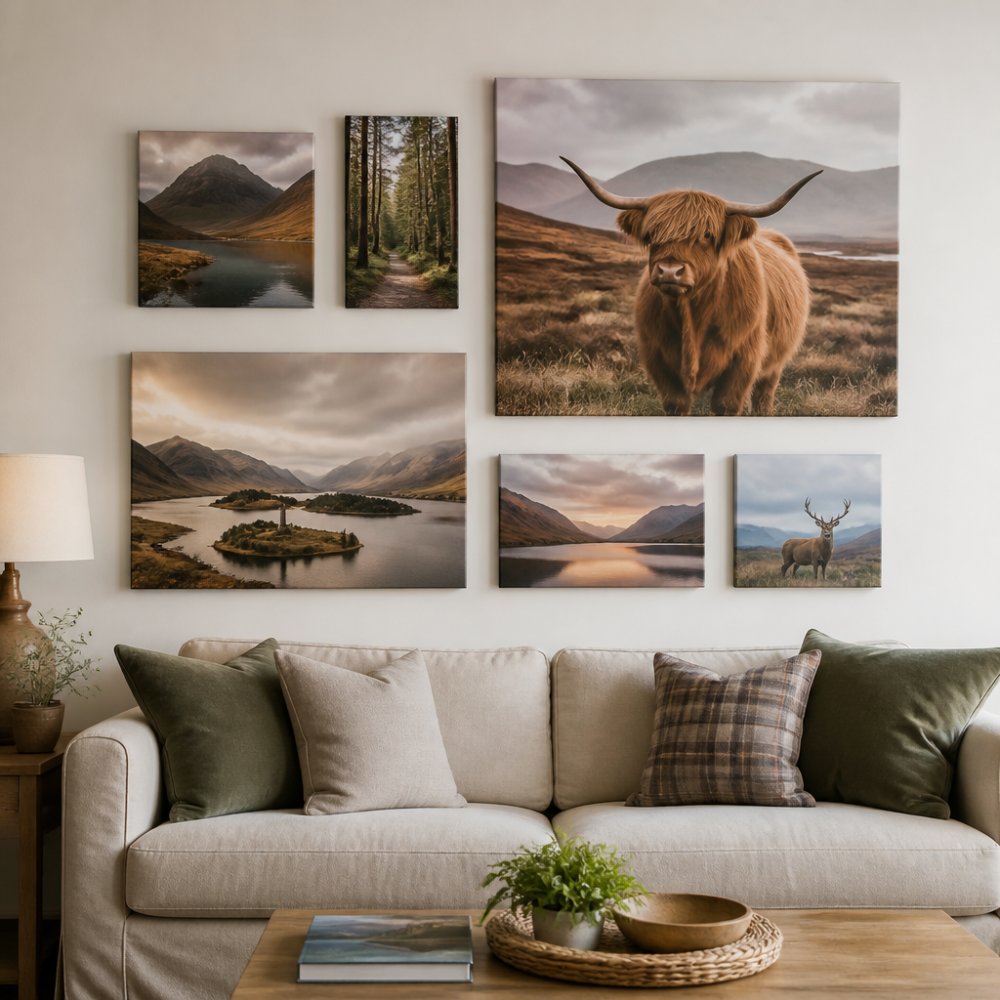
Three arrangements cover almost every room:
- Grid layout: uniform gaps, calm and ordered. Best for hallways and home offices.
- Salon layout: pieces of many sizes, densely packed. Best for period properties and stairwells.
- Organic layout: a loose cluster around one anchor. Best above a sofa or bed.
Pick the layout before you buy anything else. It determines how many pieces you need and which sizes will work.
The Grid Layout for Calm, Ordered Walls
The grid layout uses consistent spacing between wall art and a clear alignment along at least two edges. It suits rooms where you want quiet structure: a hallway, a study, a dining nook.
Keep every gap identical, usually 5-8cm. Align tops or centres, never both. A grid of six same-sized canvases reads as one large artwork, which is exactly the point.
The limitation: grids punish odd numbers. If you have five pieces and a grid needs six, buy a sixth or switch to the salon layout. Do not leave a hole.
The Salon Layout for Collected, Layered Walls
The salon layout packs different canvas art sizes tightly, often with only 4-6cm between frames. It looks gathered over time, which is precisely its charm.
Start from the centre and work outwards. Let larger pieces sit lower and smaller ones fill the upper gaps, mimicking how weight settles naturally. Keep a consistent outer boundary so the cluster reads as a single shape.
This style absorbs mismatched sizes better than any other. If you own a 30x30cm photo board, a tall landscape print and a small square canvas, the salon layout will make them look deliberate.

How Much Spacing Between Wall Art Should You Leave?
Leave 5-8cm between pieces in a tight grouping, and 8-10cm in a looser arrangement. Above furniture, keep at least 15-20cm between the bottom of the frame and the sofa back or mantel top. These are the baseline numbers most guides repeat. The difference between a wall that looks collected and one that looks accidental comes from applying them with a few simple ratios.
The spacing-to-size ratio
A reliable rule: the gap between pieces should be smaller than the smallest piece in the arrangement. If your smallest canvas is 30cm wide, keep gaps under 30cm, ideally much less. A tighter version, used by many gallery hangers, is to set the gap at roughly one-quarter to one-third of the smallest piece's width. For a 30cm canvas, that means 7.5-10cm. For a 20cm photo board, 5-7cm. This keeps small pieces from floating away from the group.
The Golden Ratio for gallery walls
The Golden Ratio (approximately 1:1.618) appears throughout nature and classical art, and it translates neatly to wall arrangements. The principle: the total width of your arrangement should relate to the width of the anchor piece by roughly 1.618. If your anchor canvas is 60cm wide, aim for a total arrangement width of around 97cm (60 × 1.618). That gives you roughly 37cm of surrounding space to distribute across smaller pieces and gaps. It is not a strict law, rooms and furniture impose their own limits, but it is a useful starting point when you are unsure how far to spread.
Vertical spacing rules
Horizontal gaps get all the attention, but vertical spacing matters just as much when you mix canvas art sizes. Align the centres of pieces in a row, not their tops or bottoms, unless you are deliberately creating a stepped effect. If you align tops, a taller piece will drag the eye upward and make the arrangement feel top-heavy. If you align bottoms, small pieces can look like they are sinking.
For stacked arrangements, one piece above another, leave a gap of 5-8cm, the same as horizontal spacing. Any wider and the pieces stop reading as a pair. Any tighter and they crowd each other.
Spacing above furniture
The 15-20cm rule above a sofa or mantel is a minimum, not a target. A common pattern is to use the height of the gap to echo the spacing between pieces in the arrangement itself. If your gallery wall uses 6cm gaps, a 15cm gap above the sofa creates a visual pause that separates the art from the furniture without disconnecting them.
For a single large canvas above a sofa, the canvas should occupy roughly two-thirds to three-quarters of the sofa's width. If your sofa is 200cm wide, aim for a canvas between 130cm and 150cm wide. Anything smaller floats; anything wider crowds the edges.
A quick reference table
| Situation | Recommended gap |
|---|---|
| Tight gallery cluster | 5-8cm |
| Loose arrangement | 8-10cm |
| Gap as fraction of smallest piece | 1/4 to 1/3 of its width |
| Above sofa or mantel | 15-20cm minimum |
| Between stacked pieces | 5-8cm |
| Total arrangement width vs anchor | Roughly 1.618 × anchor width |
Symmetrical vs Asymmetrical Wall Art: Which Suits Your Room?
Symmetrical arrangements mirror around a central axis. They suit formal rooms, fireplaces and beds. Asymmetrical arrangements balance unequal elements and suit relaxed, modern spaces.
Neither is better. The choice depends on what the room already does.
| Room Feature | Symmetrical | Asymmetrical |
|---|---|---|
| Fireplace or mantel | Strong fit | Can look unresolved |
| Above a sofa | Works if sofa is centred | More forgiving |
| Stairwell | Hard to achieve | Far easier |
| Rental property | Fewer holes | Flexible as you move |
Symmetry demands precision. If your sofa sits 10cm off-centre, a symmetrical wall will advertise it. Asymmetry hides those small irregularities and adapts when you move home.
For renters, asymmetry is the practical choice. Fewer pieces, repositioned as needed, cause less damage and less stress.
Mixing Canvas Prints With Framed Art and Photo Boards
Canvas, framed art and photo boards can share a wall if you give them a common thread. That thread is usually colour, subject or frame tone, not material.
Canvas prints have no frame, so they sit visually lighter than framed pieces of the same size. A 40cm framed print carries more weight than a 40cm canvas. Compensate by placing framed pieces lower or pairing them with a larger canvas.
Photo boards sit between the two. Our Set of Two Highland Cow - Street Art - Photo Board works well as a pair flanking a larger canvas, because the frameless finish keeps the arrangement from feeling heavy.
A simple rule for mixed materials: repeat each material at least twice. One lone framed piece among five canvases looks like a mistake. Two look intentional.
Using Paper Templates to Plan Before You Drill
Cut paper templates to the exact size of every piece, then tape them to the wall. This costs nothing and prevents the holes you would otherwise patch.
Work through it in order:
- Measure each canvas, photo board or frame and cut matching paper shapes.
- Mark the hanging point on each template, not just the outline.
- Tape the templates up and step back at least three metres.
- Leave them for a day. Adjust anything that nags at you.
- Drill only once the arrangement has survived a full day on the wall.
The template method matters most with mixed sizes, because a 5cm error is invisible on a large canvas and glaring on a small one.
Choosing Art for Specific Rooms: Sofa Walls, Mantels and Beds
Each location has its own proportions to respect. Above a sofa, the art group should span roughly two-thirds of the sofa width. Above a mantel, keep the total width narrower than the mantel itself. Above a bed, centre the arrangement on the bed, not the wall.
Sofa walls tolerate the widest range of canvas art sizes. A large anchor with two smaller companions at staggered heights fills the space without crowding.
Mantels are stricter. Heat and height mean you want pieces that sit above the shelf line with breathing room, and the arrangement should never overhang the mantel edges.
Bed walls suit symmetry. Two matching pieces flanking a central canvas is the most reliable pattern, and it survives changes of bedding and curtains.
For Scottish interiors, landscape and Highland cow artwork tends to sit naturally in these positions. Our Highland Cow Wall Art for Decor Ideas for Home collection covers both, in sizes that pair easily.

Weight, Hardware and Lighting: The Details Most Guides Skip
Hardware choice depends on the weight of the piece and the wall material, not on habit. A 30x30cm photo board needs far less support than a large framed canvas, and plasterboard needs different fixings from solid stone. This is the section most guides skip entirely, and it is where mixed-size arrangements most often fail.
Matching fixings to weight and wall type
Start by weighing each piece. If you do not have scales, estimate: a 40x40cm unframed canvas typically weighs under 1kg; a 60x90cm canvas with a solid frame can exceed 3kg; a glazed framed print of similar size can exceed 5kg.
| Weight | Wall type | Recommended fixing |
|---|---|---|
| Under 2kg | Plasterboard | Single picture hook into a stud, or a self-drilling plasterboard anchor |
| Under 2kg | Solid wall | Single picture hook with a masonry drill bit and wall plug |
| 2-5kg | Plasterboard | Two hooks spaced 10-15cm apart, or a hanging bracket fixed into studs |
| 2-5kg | Solid wall | Two wall plugs rated for the load, or a French cleat |
| Over 5kg | Plasterboard | French cleat fixed into studs, or a heavy-duty anchor rated for at least twice the piece's weight |
| Over 5kg | Solid wall | Masonry anchors rated for at least twice the piece's weight |
A common mistake is using the same hook for every piece. A hook rated for 2kg will eventually pull out of plasterboard under a 4kg canvas. Always check the weight rating printed on the packaging, and where possible fix into a stud rather than just plasterboard.
For very heavy pieces, a French cleat distributes weight across the full width of the piece rather than concentrating it at two points. This is especially useful for wide landscape canvases, where the frame itself may flex if supported only at the centre.
Lighting: the difference between flat and dimensional
Lighting changes how sizes read. A canvas lit from directly above flattens, the light hits the surface evenly and kills the texture. Light from the side reveals texture and adds depth. For a mixed arrangement, side lighting also helps separate pieces visually, because each canvas casts a slight shadow that defines its edge.
If you have track lighting or adjustable spots, angle them at roughly 30 degrees from the vertical, aimed across the surface rather than straight down. For a large anchor piece, two lights angled from opposite sides reduce shadows on the canvas itself while still revealing texture.
Managing glare when mixing canvas and glazed art
Mixing canvas (matte) with framed glass (reflective) creates a practical problem: the glazed pieces catch light that the canvas absorbs. In a room with large windows, this can make framed pieces look like mirrors while canvases look dull by comparison.
Three practical fixes:
- Angle the light. If you use picture lights, aim them at the canvas and away from glazed pieces, or use separate lights for each.
- Reposition the glazed pieces. Move them to a wall that does not face a window directly. A glazed piece on a side wall reflects less than one opposite a window.
- Use anti-reflective glazing. If you are framing new pieces, ask for anti-reflective glass or acrylic. It costs more than standard glass but eliminates most of the problem.
For existing glazed pieces, a simple test: stand where you usually sit and look at the wall at different times of day. If a glazed piece reflects a window or lamp at any point, it will do so every day. Move it or change the light.
Fading and sunlight
Hanging a canvas in direct, strong sunlight will fade the inks over time. Rotate pieces or use a blind during peak hours. For glazed pieces, UV-filtering glass slows fading but does not stop it entirely. The most reliable protection is placement: avoid walls that receive direct sun for more than an hour or two a day.
Common Mistakes to Avoid When Mixing Canvas Art Sizes
The same handful of errors appear again and again. Avoiding them is faster than fixing them.
- Hanging too high. The centre of the arrangement belongs at eye level, around 145cm from the floor.
- Making every gap different. Inconsistent spacing breaks the group into unrelated pieces.
- Buying all one size. Uniform sizes limit you to a grid and leave no room for a focal point.
- Ignoring the furniture. Art should relate to the sofa, mantel or bed below it, not float alone.
- Skipping the template stage. Every unnecessary hole costs time and filler.
- Forgetting the room's light. A beautiful arrangement in the wrong light loses its impact.
Start with one piece you love, plan the rest on paper, and let the wall grow. Browse the Ben Ledi Print Media collection to find a handcrafted canvas that anchors the arrangement, then build outwards from there.
Frequently Asked Questions
What is the 70/30 rule in art?
The 70/30 rule suggests that roughly 70 per cent of your wall art should share a common style, colour palette or theme, while the remaining 30 per cent can introduce contrast. In practice, this means three Highland cow canvases in similar tones paired with one bolder abstract piece. The rule keeps a collection feeling cohesive without becoming monotonous, and it works particularly well when you are mixing canvas art sizes across a gallery wall.
How much space should be between canvas prints?
Leave between 5 cm and 10 cm between adjacent canvases in a gallery wall. Smaller prints look best with tighter spacing, around 5 cm, while larger canvases can carry 8 cm to 10 cm without losing cohesion. Keep the gaps consistent across the whole arrangement so the eye reads it as one composition. If you are hanging art above a sofa, leave 15 cm to 25 cm between the bottom edge and the furniture.
Should all canvas prints in a gallery wall be the same size?
No. Uniform sizes create a calm, ordered look, but mixing sizes adds visual interest and lets you include a hero piece alongside supporting prints. A common approach is one large canvas, perhaps 60 cm by 80 cm, surrounded by two or three smaller pieces in the 30 cm range. Keep one element consistent, such as colour palette or frame style, so the variation in size feels deliberate rather than random.
What is the 2/3 rule for hanging art above furniture?
The 2/3 rule says your wall art should span roughly two-thirds of the width of the furniture below it. Above a 180 cm sofa, aim for an arrangement around 120 cm wide. This proportion prevents art from looking lost on a large wall or crowded on a narrow one. It applies whether you hang a single statement canvas or a grouped gallery wall.
Mixing canvas art sizes is less about perfect measurements and more about having the confidence to start with one strong piece and add deliberately. Ben Ledi Print Media handcrafts canvas wall art, framed pieces and photo boards designed to sit together across a wall, from Highland cow artwork to Scottish landscape prints. Browse the collection, choose your anchor, and build the rest around it. Get started with Ben Ledi Print Media and turn a bare wall into a considered arrangement.