
Table of Contents
- Why Canvas Art Remains a Timeless Choice in 2026
- Canvas Art vs Framed Prints: Which Suits Your Home?
- Choosing Canvas Prints for Living Room Spaces
- Styling Canvas Art Above Sofa and Key Furniture
- Framed or Unframed Canvas Prints: Making the Right Call
- Scottish Landscape Canvas Prints for Every Interior
- How to Mix Original Art with Mass-Produced Prints
- Sustainability and Material Quality in Canvas Art
- Conclusion: Why Quality Canvas Art Endures
- Frequently Asked Questions
Last Updated: October 6, 2026
Why Canvas Art Remains a Timeless Choice in 2026
Walk into any well-styled home this year and you will likely spot a canvas on the wall. So is canvas art still in style? Yes, and it shows no sign of fading. Canvas art is printed artwork stretched over a wooden frame, and its texture, depth and warmth keep it a favourite for both modern and traditional interiors. At Ben Ledi Print Media, we have watched demand hold steady because a good canvas feels like a painting, not a poster.
The reason is simple. Canvas adds texture that flat prints cannot match. That texture softens a room and draws the eye, whether you favour a bold abstract or a quiet Scottish landscape.
Style trends come and go, but certain choices endure. Canvas is one of them, and here is why:
- It suits almost any interior, from a sleek modern flat to a cosy cottage.
- It works as a focal point or as part of a gallery wall.
- It ages well when printed and stretched properly.
Below, we explain how to choose, size and style canvas art for your home.
Canvas Art vs Framed Prints: Which Suits Your Home?
The main difference comes down to finish and feel. Canvas prints sit on a stretched frame with no glass, while framed prints sit behind glass with a mount and border. Each has a place, but they create very different effects.
Canvas wins on warmth. The woven surface gives depth, and there is no glare from glass, so colours stay true from every angle. That matters in a bright living room or a hallway with strong afternoon sun.
Framed prints suit fine detail and a more formal look. A framed botanical or architectural drawing can look sharp and precise. But glass reflects light, and heavy frames can feel rigid in a relaxed space.
Here is how the two compare:
Feature |
Canvas Prints |
Framed Prints |
|---|---|---|
Surface |
Woven texture, no glass |
Smooth paper behind glass |
Glare |
None |
Can reflect light |
Weight |
Light, easy to hang |
Heavier with frame and glass |
Best for |
Living rooms, bedrooms, cosy spaces |
Formal rooms, fine detail |
Feel |
Warm, painterly |
Crisp, structured |
For most homes, canvas offers more flexibility. It sits closer to the wall, feels softer, and pairs well with almost any colour palette.
Choosing Canvas Prints for Living Room Spaces
The living room is where canvas art earns its keep. A large canvas above the sofa anchors the seating area and gives the room a clear focal point. Without one, even a well-furnished room can feel unfinished.
Start with the wall, not the art. Measure the width of your sofa, then aim for a canvas that fills roughly two-thirds of that space. Too small and it will look lost. Too large and it will crowd the room.
Think about the mood you want. A neutral space often benefits from a pop of colour, while a bold room may suit something calmer. Scottish landscape canvas prints work beautifully here because they bring both colour and calm at once.
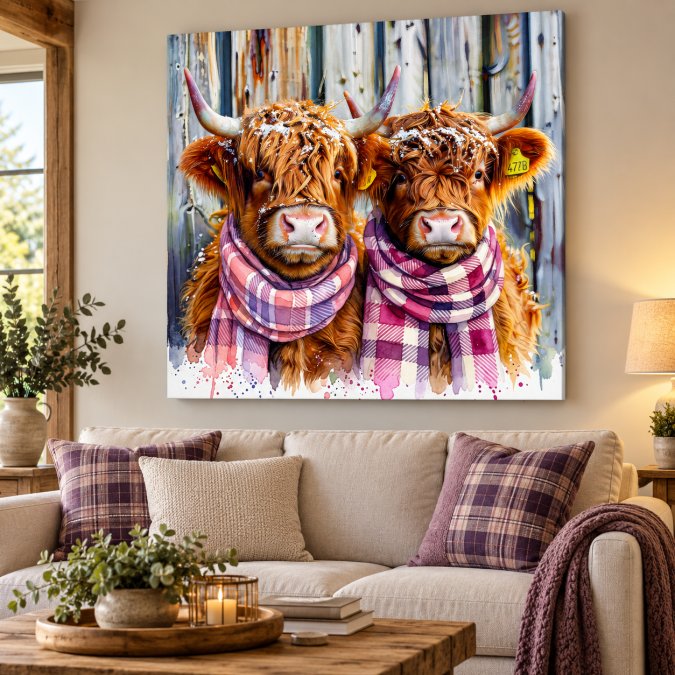
A bright modern living room with a large Highland Cow canvas print hanging above a neutral sofa, styled with cushions and a soft throw, natural light streaming from a window
A few practical tips for living rooms:
- Hang the centre of the art at eye level, around 145 to 150 cm from the floor.
- Leave 15 to 25 cm between the sofa top and the bottom of the canvas.
- For a gallery wall, lay the arrangement on the floor first.
- Keep colours tied to your cushions, rug or throw for a cohesive look.
Styling Canvas Art Above Sofa and Key Furniture
Hanging art above furniture is where most people slip up. The mistake is hanging it too high. Art should feel connected to the furniture below it, not floating near the ceiling.
For a single canvas above a sofa, centre it on the sofa, not the wall. This matters in open-plan rooms where the wall is wider than the seating. Centring on the furniture keeps the arrangement grounded.
For beds, a wide canvas or a pair of matching prints above the headboard creates a calm, balanced look. Keep the gap between the headboard and the frame small, around 15 to 20 cm.
Above a sideboard or console, a single large piece or a row of three smaller ones both work. The row should not stretch wider than the furniture beneath it.
A simple rule for spacing multiple pieces:
- Keep 5 to 8 cm between frames in a tight group.
- Keep 8 to 10 cm for a looser, airier look.
- Align the tops or centres for a tidy finish.
Framed or Unframed Canvas Prints: Making the Right Call
Both finishes have their fans, and neither is wrong. The choice depends on the look you want and the room you are working with.
Unframed, also called gallery-wrapped, means the canvas wraps around the edges of the frame. The image continues around the side, giving a clean, modern finish. This is the most popular style today because it looks effortless and needs no extra spend.
Framed canvas adds a border, often called a floating frame. The canvas sits inside a slim frame with a small gap around it, which creates a polished, gallery feel. It suits formal rooms and larger pieces that need definition.
Here is a quick way to decide:
- Choose gallery-wrapped for a relaxed, contemporary look.
- Choose a floating frame for a formal or traditional room.
- Choose a floating frame for very large pieces that need structure.
- Choose gallery-wrapped for rented homes and easy rehanging.
If you are renting and move often, gallery-wrapped canvas is the kinder option. It is lighter, needs no glass, and travels well.
Bright Harbour Scene - Contemporary Boats Canvas Wall Art →
Scottish Landscape Canvas Prints for Every Interior
Scottish scenery has a timeless pull, and it works in almost any home. The reason is the range. Misty lochs, rugged mountains and rolling glens offer calm tones that settle a room, while dramatic coastal scenes bring energy and colour.
For a neutral living room, a soft mountain or loch scene adds depth without shouting. For a bolder space, a vibrant coastal canvas can carry the room. Either way, the subject feels personal and rooted, which mass-produced abstract prints rarely achieve.
Our own collection leans into this. The Echoes Of Snow canvas translates snow-laden Highland peaks into cool tones and layered texture, ideal above a bed or sofa. For something brighter, the Eternal Tide coastal cliff canvas brings crashing waves and bold colour to a living space or office.


Highland cow artwork is another favourite, especially as a gift. It suits kitchens, hallways and snug corners, and it always starts a conversation.
How to Mix Original Art with Mass-Produced Prints
Mixing an original or handcrafted canvas with mass-produced prints is one of the most common decorating dilemmas, and most guides skip the practical mechanics. The trick is not to treat every piece equally. Instead, build a hierarchy: one lead canvas, then supporting pieces that share its palette or subject.
Start with your focal canvas. Give it the best position, usually the centre of the arrangement or the spot with the most breathing room, and let it set the colour story. Then choose supporting prints that echo one or two of its tones. A common pattern is to pull a muted green from a Scottish glen scene into a smaller botanical print, or to repeat the cool grey of a loch canvas in a photographic print of stone or sky.
When you blend canvas with other media, such as framed photographs, metal signs or wooden panels, the eye needs a consistent thread. That thread can be colour, subject or frame finish. For example, if your lead canvas is gallery-wrapped with no frame, keep supporting pieces unframed or use very slim frames so the canvas still feels like the star. If you want a more formal gallery wall, a floating frame on the canvas can tie it to framed prints without making it look heavy.
Spacing matters as much as selection. A workable rule is to keep 5-8 cm between frames in a tight group, and 8-10 cm for a looser, airier look. Align tops or centres for a tidy finish, but vary sizes so the wall does not look like a grid. Give the lead canvas more space around it than the supporting pieces, this visual pause signals that it is the anchor.
A few practical combinations that work well in Scottish homes:
- A large Scottish landscape canvas as the centre, flanked by smaller photographic prints of local flora or stone walls.
- A Highland cow canvas paired with a simple wooden sign or a black-and-white photograph of a farm track.
- A coastal canvas supported by two smaller abstract prints in the same cool palette.
If you are building a gallery wall from scratch, lay the arrangement on the floor first. Move pieces around until the lead canvas feels dominant but not isolated. Then photograph the layout before you hang anything, it is the fastest way to spot balance problems.
Sustainability and Material Quality in Canvas Art
Quality is what separates a canvas that lasts from one that sags within a year. Cheap prints fade, warp and lose tension. Well-made canvas holds its shape and colour for years, and the materials behind it matter for both your walls and the planet.
When you buy a canvas, look beyond the image. The frame, the canvas itself and the inks all affect how long the piece will look right. A solid wooden frame that will not twist over time is the foundation. Tight, even stretching with no ripples at the corners keeps the surface flat. Fade-resistant inks keep colours rich, and a clean, gallery-wrapped edge gives a frameless canvas a professional finish.
Material choice is where sustainability comes in. Canvas and wood are natural materials, and a piece that lasts for decades is kinder than one replaced every couple of years. Many quality canvas makers now use wood from responsibly managed forests and water-based or UV-cured inks that reduce solvent use. These details are not always on the label, but they are worth asking about if you want a canvas that aligns with a lower-impact home.
Longevity is the other side of sustainability. A canvas that stays taut and colour-fast for ten or twenty years avoids the cycle of buying, discarding and replacing. That is better for your wallet and for the environment. The practical signs of a well-made canvas are simple: a frame that feels solid, a surface with no loose corners, and a printed image that looks sharp rather than grainy.
Caring for canvas is straightforward. Keep it out of direct sunlight, dust it gently with a dry cloth, and avoid damp walls. Do that, and a good canvas will look right for a very long time. If you are choosing between two pieces and one feels heavier, tighter and better finished, that is usually the one that will last.
At Ben Ledi Print Media, we focus on quality materials and careful craftsmanship because we want our Scottish landscape and Highland cow canvases to be enjoyed for years, not seasons. If you are looking for a piece that combines durability with the beauty of Scottish scenery, browse our range of canvas art.
Conclusion: Why Quality Canvas Art Endures
Trends shift, but canvas art keeps its place because it does something flat prints cannot. It adds texture, warmth and depth to a room, and it works in almost any style of home. From a bold abstract to a quiet Scottish loch, the right piece turns a plain wall into a focal point.
Choosing well comes down to a few things: the right size, the right spot, and the right quality. Get those right and your canvas will feel current for years, not seasons.
If you are ready to find a piece that fits your space, browse the Ben Ledi Print Media range of handcrafted canvas art. Our collection spans Scottish landscapes, coastal scenes and characterful animal portraits, each crafted with care to bring warmth and personality to your walls. Explore the collection and find the canvas that finishes your room.
Frequently Asked Questions
Is canvas art still in style in 2026?
Yes, canvas art remains a popular choice for both modern and traditional interiors. Its enduring appeal lies in its texture, versatility and ability to act as a focal point. Scottish landscape canvas prints, in particular, offer a timeless way to bring character and a sense of place into a home, fitting seamlessly into contemporary and classic decor alike.
Are canvas prints outdated compared to framed art?
Not at all. Canvas prints have evolved significantly in quality and design. While framed prints offer a more formal look, canvas provides a softer, more contemporary aesthetic with a tactile surface. Many interior designers use canvas as a statement piece, especially gallery-wrapped styles that need no additional framing. The choice depends on your room's style and personal preference.
Does canvas look better framed or unframed?
Both options have merit. Unframed, gallery-wrapped canvas offers a clean, minimalist look that suits modern interiors and is ready to hang. Framed canvas, often using a floating frame, adds a polished, finished edge that works well in traditional settings. Consider the artwork's style and your room's overall design when deciding.
What size canvas art works above a sofa?
A common guideline is to choose art that spans about two-thirds to three-quarters of the sofa's width. For a typical three-seater, a canvas 90cm to 120cm wide often works well. Hanging it so the centre is about 145cm to 152cm from the floor keeps it at a comfortable viewing height. Always measure your space before ordering.