
Table of Contents
- What Makes Quality Framed Photo Prints Online Different
- Understanding Print Resolution and File Quality for Online Orders
- How to Choose the Right Frame for Your Photo
- Custom Canvas Wall Art: Design and Customisation Options
- Archival Quality and Photo Preservation Standards
- Sizing and Dimensions: Getting the Right Fit for Your Space
- Ready-to-Hang Canvas Prints: Installation and Display
- Framed Photo Prints for Renters and Temporary Displays
- Frequently Asked Questions
Last Updated: September 23, 2026
What Makes Quality Framed Photo Prints Online Different
When you're shopping for framed photo prints online, quality separates a piece you'll treasure for decades from one that fades and deteriorates within a few years. The difference lies in three critical areas: the paper or canvas substrate, the inks used, and the framing materials themselves.
Ben Ledi Print Media specialises in handcrafted canvas wall art that addresses these quality markers directly. Their approach focuses on superior canvas construction paired with high-quality pigment inks that resist fading.

The real distinction in framed photo prints online comes down to archival quality. Professional-grade framing uses acid-free matting, UV-protective glass, and mounting hardware designed to preserve your image.
Understanding these quality markers helps you make an informed choice. Below, we'll walk through the technical aspects that separate gallery-quality prints from mass-produced alternatives, plus practical guidance on sizing, customisation, and installation.
Understanding Print Resolution and File Quality for Online Orders
The quality of your final framed photo print depends entirely on the resolution and format of the digital file you upload. Print resolution is measured in DPI (dots per inch), and this number determines how sharp your image appears when enlarged.
For framed photo prints online, you'll need a minimum of 300 DPI for crisp, professional results. Anything below 200 DPI will show visible pixelation and loss of detail, particularly noticeable in larger formats. If your original file is lower resolution, the printer cannot recover that lost information; enlarging a low-DPI image simply magnifies the problem.
How to check if your photo is print-ready
Before uploading to any framed photo prints online service, verify your file's actual DPI. On a Mac, right-click your image, select "Get Info", and look for dimensions listed in pixels. On Windows, right-click, choose "Properties", then "Details" to find pixel dimensions. Once you have pixel width and height, divide each by your intended print width or height (in inches). The result is your DPI.
Example: A photograph that is 3000 pixels wide, printed at 10 inches wide, equals 300 DPI (3000 ÷ 10 = 300). The same image printed at 15 inches wide drops to 200 DPI, which is borderline acceptable but risks visible softness in fine detail.
If your DPI falls short, you have limited options. Upscaling software (such as AI-powered enlargement tools) can sometimes improve lower-resolution files, though results vary. The most reliable solution is requesting the original, highest-quality version from your photographer or source. Professional photographers typically shoot at 12-24 megapixels, which provides ample resolution for prints up to A2 size (420 × 594 millimetres) at 300 DPI.
File format and colour depth
Common file formats matter as well. JPEG files work for most applications, but they use lossy compression, meaning some colour and detail information is discarded. TIFF and PNG formats preserve more colour data and detail, especially if you're printing photographs with subtle gradations or fine textures. When ordering custom canvas wall art, uploading the highest-quality version of your image gives you the best final result.
Colour accuracy presents another challenge. Screen displays use RGB colour (red, green, blue), whilst printers use CMYK (cyan, magenta, yellow, black). Colours that appear vibrant on your monitor may print slightly duller or shift in tone.
Smartphone photos and digital camera files
Modern smartphone cameras capture 12-48 megapixels, which sounds impressive but often translates to lower usable DPI for large prints. A 12-megapixel phone photo (typically 4000 × 3000 pixels) prints acceptably at 11 × 8 inches (300 DPI) but becomes soft at 16 × 12 inches. If you're printing smartphone photos, keep dimensions modest or expect some loss of sharpness in enlarged formats.
Digital camera RAW files offer superior flexibility. RAW files contain more colour information than JPEGs and allow for greater adjustment during editing without quality loss. If your photographer offers RAW files alongside JPEGs, request the RAW version for printing, particularly if you anticipate large canvas prints or fine-art framing.
How to Choose the Right Frame for Your Photo
Selecting the right frame transforms a photograph into a finished piece of wall art. Frame choice depends on three factors: your interior design style, the photograph's content, and the wall space you're filling.
Wood frames suit traditional, rustic, and farmhouse interiors. They warm a space and pair naturally with landscape photography or heritage images. Metal frames, typically aluminium or steel, work better in contemporary, minimalist, or industrial settings. They provide clean lines and suit abstract or modern imagery.
Frame depth affects how your photograph sits on the wall. Shallow frames (under 2 centimetres) create a flush, gallery-like appearance. Deeper frames (5-10 centimetres) add dimension and work well for canvas prints, which have inherent texture. The frame profile, the visible edge when looking at the framed print straight on, comes in various styles: flat, bevelled, moulded, or minimalist. Your choice should complement, not compete with, your photograph's subject.
Consider the room's lighting and wall colour when selecting frame finishes. A light wood frame can brighten a dark wall, whilst a dark frame anchors a bright, neutral space. Metallic finishes (gold, silver, bronze) add sophistication and work across multiple interior design schemes.
Ben Ledi Print Media's ready-to-hang canvas prints come with mounting hardware already fitted, so you're not choosing a separate frame; the canvas itself becomes your wall art. This simplifies the decision if you prefer a cohesive, professionally finished look straight from the box.
Custom Canvas Wall Art: Design and Customisation Options
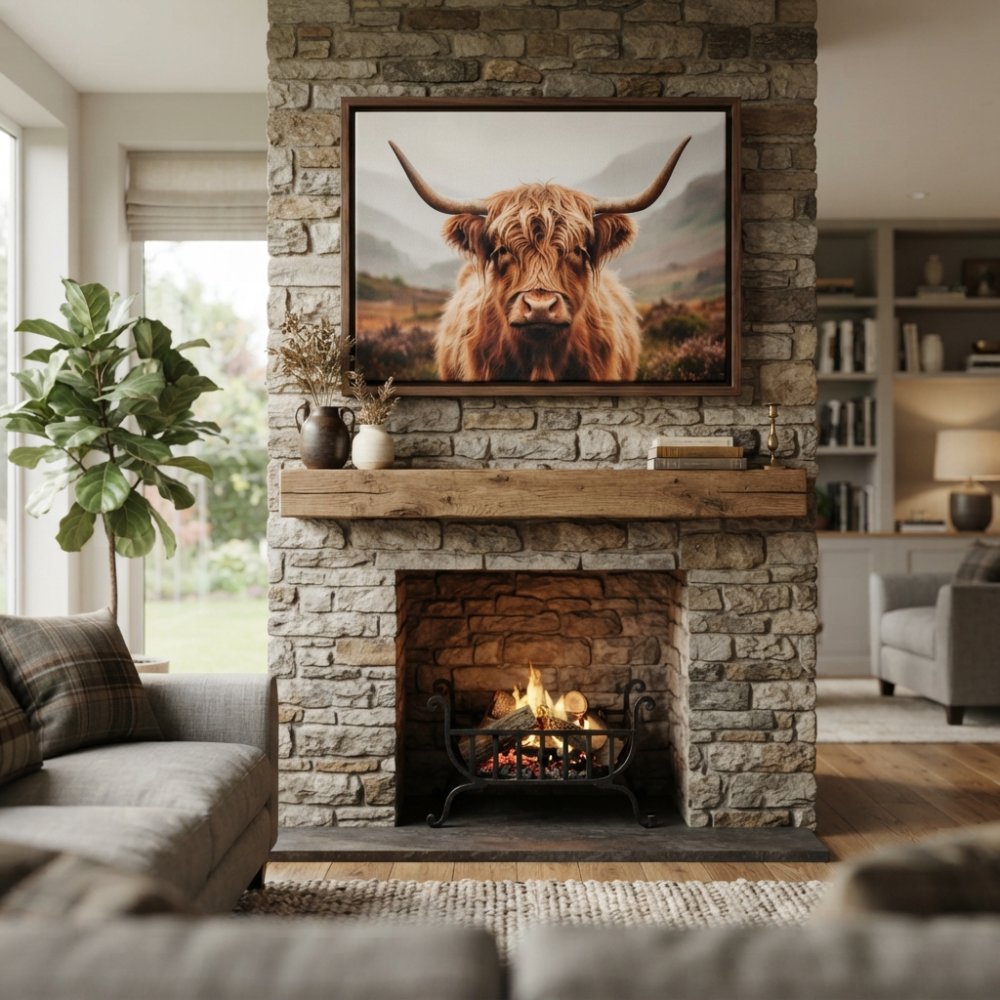
Custom canvas wall art allows you to move beyond standard prints and create something genuinely personal. The customisation process typically begins with uploading your image and selecting your desired dimensions.
Canvas prints offer advantages over traditional framed photo prints online. Canvas has natural texture that adds depth and visual interest, particularly under directional lighting. The image is printed directly onto the canvas surface, then stretched over wooden bars (called stretcher bars) and secured on the back. This creates a gallery-wrapped appearance without needing a separate frame.
Aspect ratio matters when customising. If your original photograph is a standard 4:3 ratio but you want a 16:9 canvas for a wide wall space, the image will be cropped. Understanding how this affects your composition prevents disappointment.
Ben Ledi Print Media's collection includes whimsical Highland cow designs and Scottish landscape imagery, each available in multiple sizes. Their handcrafted approach means each piece receives individual attention, ensuring colour accuracy and print quality. Browsing their range of canvas art lets you see how different designs work in various room settings.
Archival Quality and Photo Preservation Standards
Archival quality refers to materials and processes designed to preserve photographs for 100 years or more without significant fading, yellowing, or deterioration. This matters if you're investing in framed photo prints online that you want to pass down or display long-term.
Matting and mounting foundations
Acid-free matting is fundamental to archival framing. Standard cardboard contains lignin, which oxidises over time and causes yellowing and brittleness. Acid-free alternatives resist this chemical breakdown. If your framed print includes matting, confirm it meets archival standards.
Understanding glass types for framed prints
Ben Ledi Print Media: Highland Cow Wall →
Acrylic alternatives are sometimes offered as a lighter-weight, shatter-resistant option. Acrylic yellows over time and scratches more easily than glass, making it less suitable for archival applications. It works for temporary displays or high-traffic areas where breakage is a concern, but not for preservation-focused framing.
Inks and canvas longevity
Pigment-based inks are more resistant to fading from light exposure and humidity changes. Ben Ledi Print Media uses high-quality pigment inks as standard for their canvas prints.
Canvas itself, when properly constructed, provides excellent archival properties. Ben Ledi Print Media uses superior canvas construction for lasting quality.
| Preservation Factor | Standard Quality | Archival Quality | Longevity Impact |
|---|---|---|---|
| Matting | Standard cardboard | Acid-free or 100% cotton rag | 10-20 years vs 100+ years |
| Glass | Standard or non-glare | Museum-grade (99% UV block) | Noticeable fading within 5 years |
| Inks | Dye-based | Pigment-based | Colour shifts within 2-3 years |
| Canvas | Budget synthetic | 100% cotton or cotton-blend | Brittleness and warping risk |
| Mounting | Permanent adhesive | Reversible supports | Damage risk during future conservation |
Environmental conditions and display practices
Storage conditions affect preservation as much as material quality. Framed photo prints online displayed in direct sunlight, high humidity, or temperature-fluctuating rooms deteriorate faster, regardless of material quality. Keeping prints away from radiators, damp walls, and south-facing windows extends their lifespan significantly.
Ideal display conditions are 18-21°C with 30-50% relative humidity. Fluctuations in temperature and moisture cause canvas to expand and contract, stressing the stretcher bars and potentially warping the image. In damp climates or rooms prone to condensation (bathrooms, kitchens), canvas prints are more vulnerable than framed prints with sealed glass protection.
UV-filtering window film offers an additional preservation layer if your prints hang near windows. This film blocks 99% of UV radiation whilst allowing visible light through, protecting your artwork without darkening the room. For valuable or sentimental prints, this modest investment extends display life considerably.
Sizing and Dimensions: Getting the Right Fit for Your Space
Choosing the wrong size is one of the most common mistakes when ordering framed photo prints online. A print that's too small looks lost on a large wall; one that's too big overwhelms the space and feels cramped.
The rule of thumb is that your framed print should occupy roughly 50-75% of the wall space above a piece of furniture or in a defined area. For a sofa wall, measure the sofa's width and aim for a print that's 60-75% of that measurement. This creates visual balance without the print appearing undersized or oversized.
Aspect ratio, the relationship between width and height, matters equally. A portrait-oriented print (taller than wide) suits narrow wall spaces. Landscape orientation (wider than tall) works for expansive walls or above long furniture pieces. Square prints add modern sophistication and work well in gallery-wall arrangements.
Distance from viewing also affects sizing. Prints viewed from across a room (3+ metres away) can be larger without overwhelming. Prints viewed up close, such as above a desk or bedside table, should be more modest in size.
Ben Ledi Print Media's canvas prints come in multiple sizing options, allowing you to match your wall dimensions precisely.
Ready-to-Hang Canvas Prints: Installation and Display
Ready-to-hang canvas prints eliminate the complexity of framing and professional installation. The canvas arrives pre-stretched, mounted on wooden stretcher bars, with hanging hardware already attached. You simply choose a location, find the studs in your wall (or use appropriate anchors), and hang.
Installation requires minimal tools: a level, a drill or hammer, and wall anchors suitable for your wall type (plasterboard, brick, or stone). Most ready-to-hang prints come with picture hooks or D-rings rated for the weight of the canvas. Heavier pieces may need two hanging points for stability.
Proper installation affects both safety and appearance. A level print looks intentional; a crooked one draws the eye and detracts from the artwork. Use a spirit level to ensure your canvas hangs straight before securing the second hook.
Canvas prints work well in nearly any room. Their durability suits high-traffic areas like living rooms and hallways. The texture adds visual interest without requiring a frame, and they complement both minimalist and eclectic interiors.
Maintenance is straightforward. Dust your canvas gently with a soft, dry cloth every few months. Avoid direct sunlight, which fades pigments over time, and keep the canvas away from moisture and humidity. These simple precautions keep your ready-to-hang canvas print looking fresh for years.
Framed Photo Prints for Renters and Temporary Displays
Renting presents challenges when decorating with framed photo prints online, you want to personalise your space without damaging walls or losing your security deposit. Fortunately, several solutions let you enjoy quality wall art without commitment.
Canvas prints on stretcher bars are ideal for renters. They're lightweight, require minimal wall damage, and can be removed cleanly without leaving marks. Adhesive picture hanging strips (designed specifically for artwork) hold canvas prints securely whilst peeling away cleanly when you move. These strips work on most wall surfaces, including textured plasterboard.
Leaning prints against furniture offers another temporary option. Oversized framed photo prints online can rest on a shelf, dresser, or console table, creating visual impact without any wall installation. This approach works particularly well in bedrooms or living spaces where a substantial focal point enhances the room without permanent commitment.
Ben Ledi Print Media's ready-to-hang canvas prints work perfectly for renters. Their lightweight construction and simple hanging hardware mean you can display them in seconds and remove them just as quickly. Whether you're in a flat for one year or five, their handcrafted designs add personality without long-term commitment.
Choosing quality framed photo prints online involves understanding the materials, resolution requirements, and preservation standards that separate lasting artwork from temporary décor. The investment in archival-quality prints, proper sizing, and thoughtful installation transforms your walls into a gallery that reflects your taste and withstands time.
Ben Ledi Print Media specialises in handcrafted canvas wall art designed for exactly this purpose. Their superior canvas construction, high-quality pigment inks, and attention to detail ensure your prints remain vibrant and beautiful for years. Browse their curated collection of Highland cow artwork, Scottish landscapes, and distinctive designs to find the perfect piece for your space. Add a canvas print to your home today and discover how quality wall art elevates your interior.
Frequently Asked Questions
What should I look for when ordering framed photo prints online?
Look for high-quality canvas and pigment inks. Verify the print resolution requirements (typically 300 DPI minimum) and confirm the mounting hardware is included. Handcrafted canvas wall art should specify its preservation standards and offer ready-to-hang options to avoid installation hassles.
How do I ensure my digital photos are high enough quality for large prints?
Your image resolution should be at least 300 pixels per inch (DPI) for professional results. For a standard online print order, calculate the required resolution by multiplying your desired print width and height in inches by 300. For example, an 8x10 inch print needs a file of at least 2400x3000 pixels. If your photo is smaller, ask your provider about upscaling options or consider a smaller print size. Most providers specify their resolution requirements before you upload.
Is it better to order framed prints or canvas wall art?
Canvas wall art provides a gallery-quality aesthetic and works well for contemporary or rustic interiors. Choose canvas for bold design statements and easier customisation. Our canvas prints are ready-to-hang and work equally well for renters.
What's the difference between standard prints and handcrafted canvas art?
Handcrafted canvas art is individually created using high-quality pigment inks, with careful attention to colour accuracy and detail. The craftsmanship means each print is treated as a unique piece rather than a generic reproduction, resulting in superior archival quality and visual impact.